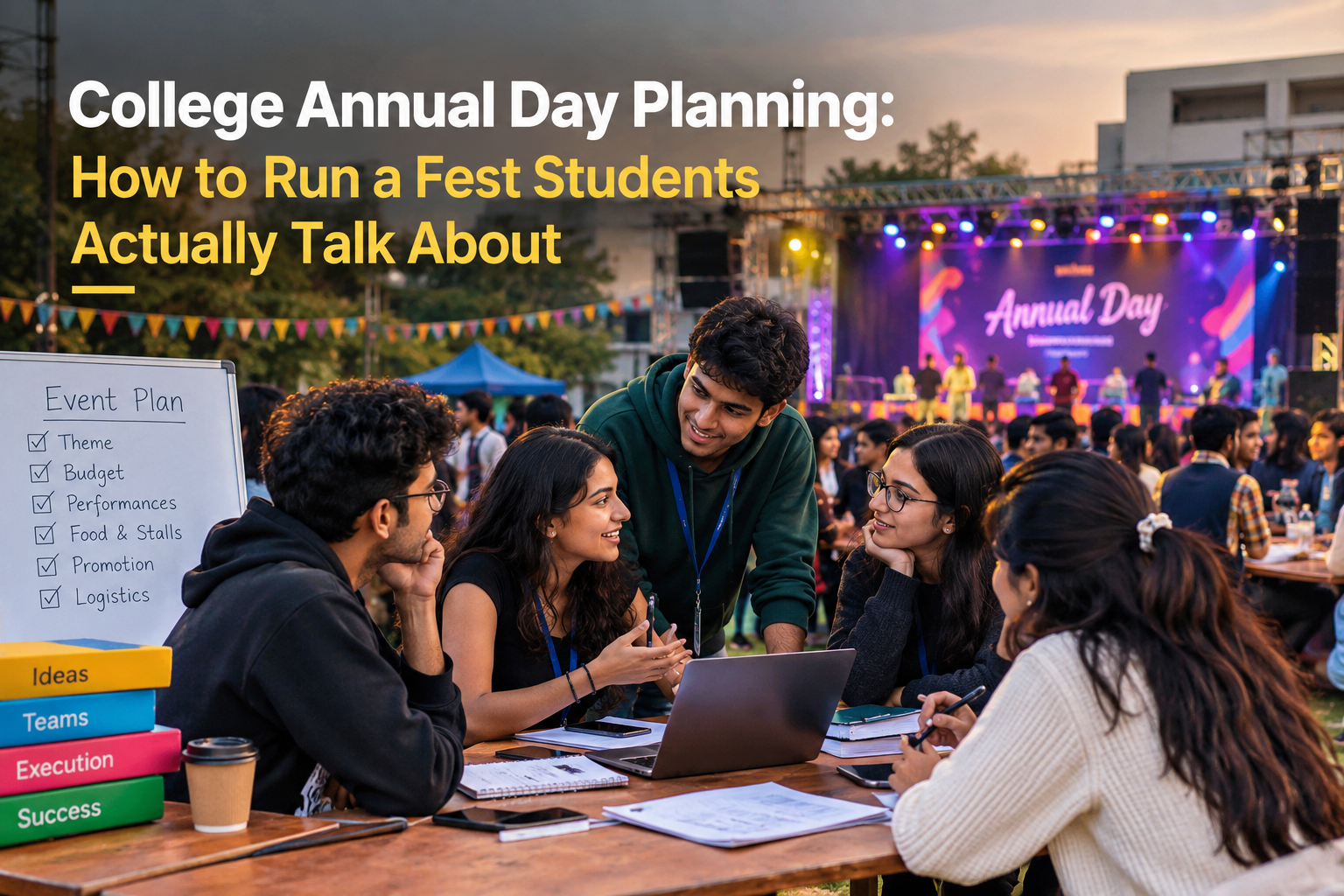
Every cultural committee starts the year with the same line: this year’s annual day is going to be different. Then the actual work of college annual day planning gets rushed into the last three weeks, the run of show gets copied from last year’s notes, and by the time semester exams roll around, nobody outside the front row remembers the event happened.
If you’re the one holding the file this year, here’s how to plan a college annual day step by step, without losing the last three weeks to panic. It covers the committee structure, the budget conversation, the permissions nobody mentions until they’re overdue, and the details that actually make an audience talk about a fest a year later.
Set up a committee, not a to-do list
Most annual day planning falls apart because one or two people try to hold the whole thing in their heads. Bigger fests split the work into a real structure. At IIT Bombay’s Techfest, organisers run a three-tier setup, a core team of around twenty student managers, each leading their own group of coordinators who handle one slice of the event, according to a Careers360 report on how Indian college fests get organised. Your annual day doesn’t need twenty managers, but the logic scales down fine, and the same structure works for school annual function planning Gurgaon committees already use, just with teachers running point instead of student coordinators.
A workable split for a single-day college annual day or department fest:
- Stage and programming: run of show, performer bookings, rehearsal schedule
- Décor, sound and lighting: vendor coordination, stage design, technical checks
- Logistics and hospitality: seating, guest management, refreshments, transport for outside performers
- Publicity and documentation: invites, social posts, photography, and the paperwork your principal’s office will ask for later
Give each team one point person who reports to a single coordinator, instead of the faculty in charge fielding six separate updates a day.
College Annual Day Planning Budget Guide
Budget conversations usually happen after the theme is picked, which is backwards. Colleges that reverse the order, treating college annual day planning as a budget-first exercise, spend less time re-negotiating vendor quotes in the final week.
|
Scale |
Example |
Approx. budget |
Source |
|
Single day, department-level fest, in-house talent |
Ananya Cultural Fest, K.S. Institute of Technology, Bengaluru (2019) |
Around Rs 6 lakh |
The college’s own NAAC Criterion 5 report |
|
Single day annual day with one outside performer and full décor |
A typical mid-size Delhi NCR college annual day |
Several times the above; varies by act and vendor |
Estimate, not independently sourced |
|
Multi-day inter-college fest with headline performers |
Large Delhi University fests |
Rs 1.5 crore and up, footfall near 50,000 |
India Today |
Most college annual days sit well below the top row. A single-day event with one outside performer, proper stage décor and a sit-down arrangement for guests will usually land somewhere in the middle, and the real driver of cost is usually the stage and lighting rig, not the performer fee. If you’re benchmarking college fest budget India numbers before pitching your committee, use the table above as a starting range rather than a fixed quote, since every annual day event management company prices décor and sound differently depending on the venue.
College Annual Day Theme Ideas 2026
Theme selection is often treated as the fun part of college annual day planning, but it works best as the last major decision, not the first. Most college fest organizing ideas lists online repeat the same four words: retro, Bollywood, futuristic, cultural. None of that tells you how to execute the day. A theme only earns its keep if it shapes three things you’ll actually build: the stage backdrop, the entry or photo-booth corner, and one recurring bit that ties segments together.
A few directions that give you more to work with than a generic label:
- A departmental showcase built around your college’s strongest programme, a fashion college leans into a runway segment, a tech college adds an innovation-fair corner alongside the cultural stage
- One decade or film era, committed to fully rather than “retro” in general, so décor, costumes and the music briefs stay consistent
- A regional theme tied to where a large share of your students are from, which usually pulls stronger participation for folk dance and food stalls
- A cause-linked theme with one visible, physical element on the day, a recycled-material stage backdrop rather than just a mention in the anchor’s script
- A “then vs now” split comparing the college’s founding era with today, which works well for older institutions with real archive photos to draw on
If you’re stuck between two options, borrow a trick from Regional College of Management in Bhubaneswar, whose planning notes for their Brahmastra fest recommend testing a shortlisted theme with a quick student poll and aiming for at least 70% approval before locking it in.
Sort the permissions before the paperwork sorts you
This is the step most college annual day planning guides skip entirely, and it’s the one most likely to blow up your event day if you don’t sort it early. If your annual day includes an outdoor stage, DJ or PA system, this is the part most committees find out about too late. Under Rule 5 of the Noise Pollution (Regulation and Control) Rules, 2000, notified by the Ministry of Environment and Forests, a loudspeaker or public address system can’t be used without written permission from the district magistrate, police commissioner or an officer of at least Deputy Superintendent of Police rank, and it can’t run past 10pm except inside a closed venue like an auditorium or banquet hall. The same rules set decibel limits by zone, 55 dB by day and 45 dB by night in a residential area, dropping to 50/40 dB in a designated silence zone, which typically covers the area around schools, courts and hospitals.
Haryana adds its own enforcement layer on top of this. Acting on directions from the Punjab and Haryana High Court, Haryana Police issued state-wide guidelines restricting loudspeaker and PA system use at both public and private venues, tightening the 10pm cut-off, according to Hindustan Times. If your event is on an open lawn in Gurgaon rather than inside a hall, get the permission application moving two to three weeks out, not two to three days.
Document everything, because NAAC will ask for it later
If your institution holds or is working toward NAAC accreditation, this year’s annual day isn’t just an event, it’s evidence. NAAC’s framework includes a specific metric, 5.3.3 under Criterion 5 (Student Support and Progression), that calls for a report on sports, cultural competitions and academic fests as part of the Self Study Report colleges submit for assessment.
That means photographs, attendance sheets, a budget statement and a short write-up aren’t optional extras for whoever got assigned “documentation” on the committee. Build them in from day one: assign someone to shoot proper stage and audience photos, not just phone snaps from the wings, keep a signed attendance register at entry, and draft the event report within a week while details are still fresh.
Build a run of show that survives reality
Write the run of show with real buffer built in, not the optimistic version. A felicitation segment scheduled for ten minutes reliably takes eighteen once the principal starts speaking. Block at least 15 to 20% slack into your total programme length, and place your most reliable act, not your flashiest one, right after any segment likely to overrun, so a late start doesn’t cascade into cutting music sets short later in the evening.
For real annual day anchoring script tips: brief your anchors properly, and treat the script as a working document, not a page of jokes. It needs transition lines for every segment change, the correct names and designations of every guest being felicitated, and a fallback line for when a performer isn’t ready on cue. Give your anchors the final run of show at least two days before the event, not two hours.
When it’s worth bringing in a professional partner
Some committees run every annual day in-house and do it well. Others reach a point, usually once the guest list crosses a couple of hundred people or the event moves outdoors, where stage engineering, sound calibration and vendor coordination start eating more hours than the academic calendar allows.
That’s usually where a professional partner earns its cost back, not by replacing the student committee, but by handling the parts that carry real risk if they go wrong: rigging, sound levels, backup power, and the permissions covered above. Eventalist & Decor is the annual day event management company Delhi NCR colleges and schools already turn to, for stage design, décor, sound and lighting, permissions support and on-ground coordination on the day, so your committee can focus on the programme instead of the paperwork.
That’s really the whole shape of college annual day planning: commit to the boring layers first, budget, committee, permissions, before you spend energy on the theme and the run of show. Start planning at least six to eight weeks out if you’re bringing in outside performers or vendors, and closer to ten to twelve weeks if you need police or district-level sound permissions. If you want a second opinion on your budget, run of show or permissions checklist before you lock a date, reach out to Eventalist & Decor’s college and school events team for a planning call.
It depends entirely on scale, and college fest budget India figures vary widely because of it. A single department-level fest can run around Rs 6 lakh, based on one Bengaluru college’s own NAAC report, while large multi-day university fests have reported budgets past Rs 1.5 crore. A typical single-day annual day with one outside performer sits somewhere in between.
Yes. This is one of the most common DJ sound permission college event India questions we get, and the short answer is yes if you’re using a loudspeaker or PA system, especially outdoors. Under the Noise Pollution (Regulation and Control) Rules, 2000, you need written permission from the district magistrate, police commissioner or a DSP-rank officer, and in Gurgaon specifically, Haryana Police enforces its own additional restrictions on top of the central rules. The system generally can’t run past 10pm outside a closed venue.
Six to eight weeks for a standard single-day event with outside vendors. Push that to ten to twelve weeks if you need sound or venue permissions from the local authorities.
Skip the generic “retro” or “cultural” label and build the theme around something specific to your campus, a strong department, a regional identity, or a founding-era vs today split. Validate your top pick with a quick student poll before committing.
Student anchors work well for a campus-only audience and keep the tone authentic, but for larger events with senior guests, a professional emcee paired with one student co-host usually keeps the pacing tighter.
Tie the theme to something specific to your campus: a strong department, a regional identity tied to where your students are from, or a founding-era vs today split for older institutions. Validate your top pick with a quick student poll before committing, rather than going with whatever the loudest voice in the committee wants.